
The first bag of Greenies sat in my pantry for two weeks before I opened it. I had read the reviews, all 24,000 of them, and I still was not convinced that a chew could do enough for Juno's teeth to be worth the space. What finally changed my mind was not the advertising. It was our vet mentioning, during a routine checkup last fall, that the tartar on Juno's back teeth was starting to build up and her breath was not doing her any favors. I am not a vet, and I make no pretense of being one. I am a 54 year old woman outside Asheville, North Carolina, with an 8 year old, 62 pound lab and hound mix named Juno. For about eighteen months, most days, she has gotten one Greenies large dental chew after dinner. There are things I wish someone had told me before I bought that first bag, so here is the review I was looking for.
To be clear about what this review is not. It is not a claim that Greenies changed our lives, because a dental chew should not have to change your life. It is not a list of obvious features you can read on the package. It is the honest middle ground: what I noticed, what surprised me, what I did when something worried me, and the moments I almost gave up on them. If that sounds less exciting than the usual review, good. That is the point.
The Quick Verdict
A daily dental chew that does what it claims while you actually use it, but the smell, the reorder pace, and a digestion curveball mean it is not right for every dog. Juno and I rebuy it anyway.
Amazon Check Today's Price →Before You Buy a Bag, Read What Eighteen Months Taught Me
Juno has worked through roughly four hundred fifty of these. The full honest review below covers sizing, digestion surprises, and what I would do differently. If you decide they belong in your cart, this button takes you to today's listing.
Amazon Check Today's Price on Amazon →How I've Used Them With Juno
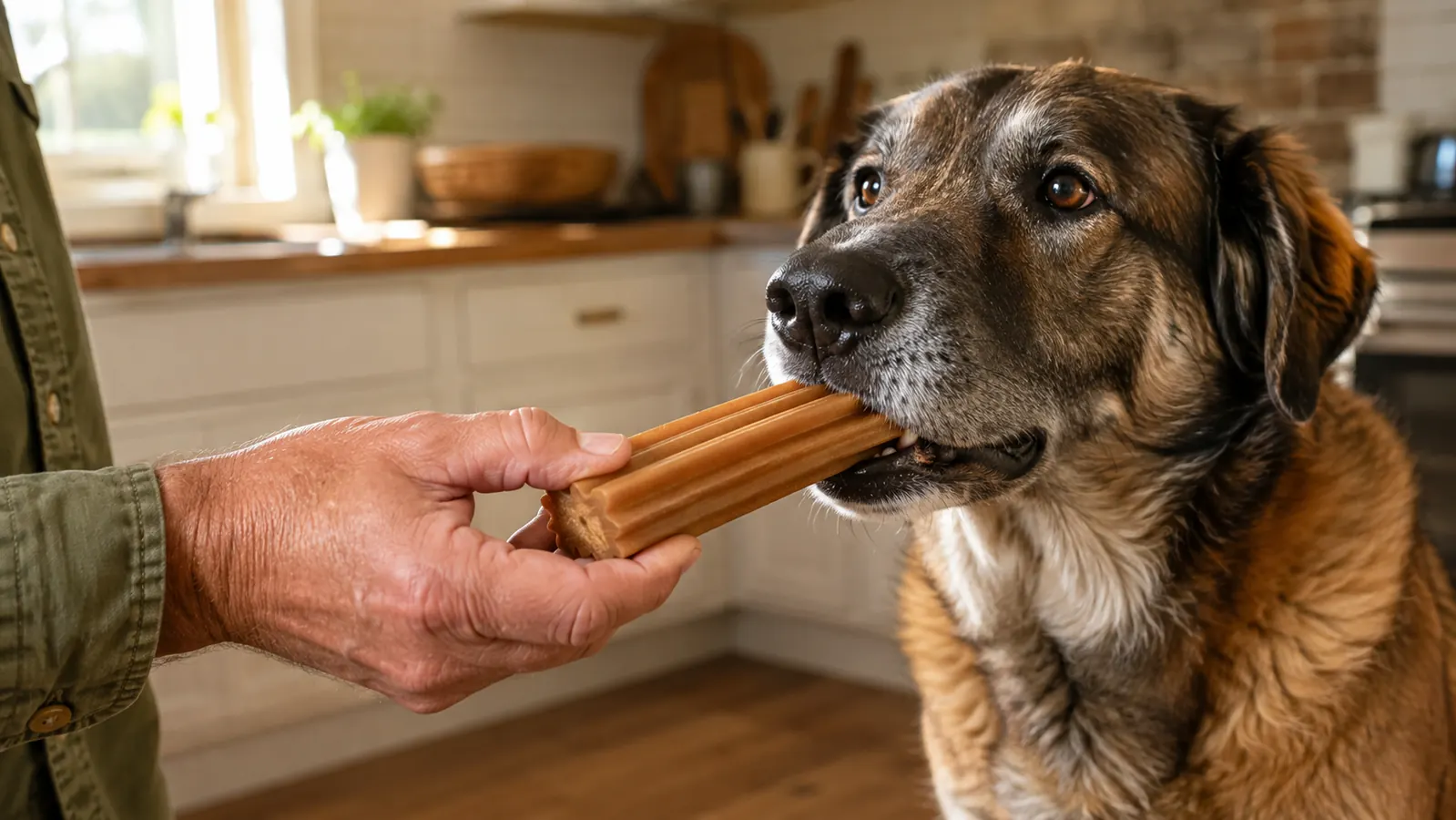
Juno is an eight year old, 62 pound lab and hound mix from the county shelter, and she has always been what our vet kindly calls an eager eater, which is another way of saying she inhales. In the first week with Greenies I did something the package did not tell me to do. I cut one large chew into quarters and gave her a single quarter, to see how fast she would get through it and whether she would chew or just try to swallow. The first quarter took her maybe forty seconds. The next one took a minute. By the end of the first month she was working a whole chew for four or five minutes, and that is the whole point, because the teeth only get scrubbed when the chewing actually happens.
The routine that stuck looks like this: one large chew after her evening meal, five or six days a week, given on the back deck in warm months and on the kitchen rug when there is snow on the ground. I brush her teeth a few times a week as well, because our vet said something I have not forgotten, that a chew is an extra and not a replacement for brushing. Pepper, the eleven year old cat, watches the whole ceremony from the top of the stairs with what I can only describe as professional disdain. This has been our pattern for about eighteen months now, through two winters and one very rainy spring, and it has become as ordinary as making coffee.
I first really noticed a difference around the six week mark, not by grabbing her jaw and inspecting it, but by looking at the big rear teeth when she panted after a hike on the blue ridge trails. The brownish staining that had been building on the chewing surfaces looked thinner to me, and the breath had improved enough that I stopped apologizing when she leaned against visitors. I cannot promise those results for your dog. Dogs differ in how they chew and what they eat. I can tell you what I saw with mine, and around when I saw it.
What the Package Does Not Tell You Before You Open It
Now the things the package does not tell you, starting with smell. The chews have a scent somewhere between a breath mint and a soup stock cube, and it is strongest in the first minutes after you open a fresh bag. It does not bother me, but it is unmistakable, and if you have a sensitive nose you will want a sealed container or a cabinet door between you and the bag. A friend who watches Juno when I travel keeps her own bag in a tin on the back porch for exactly that reason, and I thought she was being dramatic until I smelled a fresh bag myself.
The second surprise is temperature. Greenies are spongy by design, and that design does not love heat. Last July I carried a bag out to the car and forgot to bring it back in before an afternoon of errands, with Juno safely at home. Six hours in a hot car turned the bottom chews into a single fused slab. They broke apart fine once they cooled, and she ate them without complaint, but I learned two things. Store them in a cool cabinet, not near the stove, and never leave them in the car in summer.
The third surprise is crumbs, and this one is on me for not expecting it. The whole mechanism of a chew like this is that the outside abrades, which means pieces come off. Juno eats on the back deck, and every few days I sweep little bits off the boards, and a few have made it down the eleven stairs into the yard for the birds. Indoors it would be the same story in the rug. None of that is a reason not to buy them. It is just a thing you should know before you serve them on your best carpet.
Sizing, and What One a Day Really Means
Sizing is where I had to unlearn what the pictures on the bag suggested. The photos show a dog holding something that looks modest. The large size is not modest. My first large chew was longer than my index finger and thicker than my thumb, and on Juno, who is on the smaller end of what a large is meant for, it looked borderline comical for the first few days. She figured it out fast, and the size is genuinely the reason she slows down. If all she had to do was crunch and swallow, we would not be having this conversation.
The back of the bag gives you the math by weight, and it is worth reading before you grab a box. Small chews are for little dogs, medium for dogs in the twenty five to fifty pound range, and large for dogs over fifty. Juno, at 62 pounds, sits in the middle of the large group. My rule after eighteen months is simple. If your dog sits exactly on the line between two sizes, try the larger one first, because a chew that can be bolted in two swallows is doing nothing for the teeth. A chew that takes a few minutes might be the safer mistake.
What one chew a day means for your shopping routine is the number that surprised me most of all. A 24 count bag, fed at the rate of one chew per day, lasts exactly 24 days. That means a new bag roughly every three and a half weeks, not once a month, and it is amazing how many reviews leave that out. We set a standing reminder now and order two bags at a time, because I got tired of the pattern where the bag ran dry on a Sunday night and the only box on the shelf was the small size. Planning for that little rhythm instead of being surprised by it took away most of the frustration.
The Digestion Question Everybody Wants Answered
Time for the question that shows up in comment sections everywhere, the one that polite reviews skip. For the first couple of weeks with Juno, part of the chew came out the other end looking remarkably similar to how it went in. I am going to be direct without being graphic, because this genuinely matters to people deciding whether to buy. I saw what looked like poorly chewed pieces in her stool, enough that I called our vet's office and described what I was seeing. The answer was calm and practical. This is common when a dog is not chewing a new chew thoroughly, and the fix is usually chewing, not panic.
When I started, I gave the chew right before her dinner, because that was when she was most excited about anything food related. That turned out to be exactly the wrong time. An already hungry dog will inhale anything. I moved the chew to after her evening meal, when she was full and far more willing to pace herself, and for the first few weeks I stayed on the deck with her and watched the first couple of minutes of chewing. It felt silly at the time, but it gave me a clear picture of how she was actually eating. Within about three weeks I stopped finding intact pieces, and by the end of the first month the issue was gone.
The lesson, for us at least, is not that the chew is hard to digest. It is that any chew, any biscuit, any piece of food that gets swallowed in chunks instead of chewed will come back through in chunks, and that is worth watching in the first weeks of anything new. If your dog is a gulper by habit, or has a sensitive stomach and reacts to new treats, ask your own vet before you start. I did, and the answer made sense to me.

Breath Results and the Alternatives I Tried First
Breath first, because that is the reason most people buy these. Within about two weeks of daily use Juno's breath improved from 'apologize when she greets guests' to a level I would call normal for a dog. It was not magic and it was not perfume at the source, which mattered to me. I did not want a mouth that smelled like mint air freshener. I just wanted to stop grimacing. At her regular checkup, our vet did not find any dramatic change, but the tartar situation had not gotten worse, and in an eight year old dog I will take steady over dramatic.
Now the part that almost nobody tells you, which is that the effect only lasts as long as you keep up with the routine. Last winter Juno had a stomach upset for about ten days, the vet said to pause treats, and by the end of that stretch her breath had slid most of the way back to where it started. A product is not a failure because its effect depends on using it. But if you are the kind of person who will forget on week two, or who travels without the bag, adjust your expectations. These are maintenance, not a cure.
I did not start with Greenies. I started the way most people do. First came a grocery store dental biscuit that Juno loved and finished in under a minute, which should have told me everything. Then a set of dental wipes she tolerated exactly once before treating them as a game. Then more stubborn toothbrushing, which works only on the teeth she lets me reach, meaning mostly the front ones. None of those were bad. They just did not match how my dog actually eats.
What brought me back to Greenies and kept me here is texture. The spongy resistance is what forces a slow chew, and Juno is not a methodical chewer by nature. She needed a chew that would make her work, and this one does. If you have a naturally methodical dog, a simpler biscuit might serve you fine, and you should not feel guilty about that choice. For our household, the daily habit stuck, and the habit is the real test of any product like this.
The breath came back within about ten days when we paused the routine. That is what taught me the truth about Greenies: they are maintenance, not a cure.
What I Liked
- Forces my dog to slow down and actually chew, which is the whole mechanism.
- Visible difference on Juno's rear teeth after about six weeks of consistent use.
- Simple enough routine that it stuck for eighteen months, which is the real test.
- Spongy texture feels gentler on older teeth than a hard biscuit.
Where It Falls Short
- The bag has a strong smell when freshly opened.
- A 24 count bag lasts 24 days, so the reorder pace is easy to underestimate.
- Crumbs end up on the deck, the rug, and under the furniture.
- The breath benefit fades within about ten days if you stop giving them.
- Not a replacement for brushing or for a vet visit when a tooth is already bad.
Who This Is For
Buy these if you own a dog who is big enough for the matching size, who chews rather than inhales, or who can learn to chew with a little patience. They suit owners who are home most days and can keep a routine, and dogs whose stomachs tolerate treats without drama. Buy them if you want a daily extra to run alongside brushing, not a replacement for it. If that sounds like your household, a bag is worth trying, and the first bag will tell you more than any review can.
Who Should Skip It
Skip them if your dog is a known gulper who swallows even large treats in two bites without much chewing, because you will watch the results pass through mostly unchanged, and that is unpleasant for everyone. Skip them if you are looking for a cheap replacement for brushing or for a dental cleaning your vet has already recommended, because no chew does that work, and putting off veterinary care to save money is the most expensive decision you can make.
Skip them if you cannot be consistent, because the benefit fades fast when the routine stops. And if your dog has a long history of food sensitivities or a stomach that objects to new things, have a conversation with your own vet before you spend money on a bag, and try a single chew rather than committing to a whole box.
My Honest Recommendation, From My Kitchen Table
Juno still gets one most evenings, and I plan to keep that up. If your dog chews like mine, start with a bag in the right size, store it in a cool cabinet, and give the chew time to do its job. If it is not a fit, you will know within the first bag, and that is exactly what the first bag is for.
Amazon Check Today's Price on Amazon →