

Juno turned eight this spring, and I noticed it in her legs before I noticed anything else. She is a 62 pound lab and hound mix, and for years she took our deck stairs two at a time. Lately she pauses halfway down the eleven steps, and on damp mornings she walks stiff for the first few minutes. Our vet, who runs a small two-room practice twenty minutes from my house, said her hips were getting tight and gave me the usual talk about weight and exercise. She did not push a supplement. I was the one who started asking around, and every person I trusted named Nutramax Cosequin first.
I am not a vet and I never pretend to be one. I am 54 years old, I live outside Asheville, North Carolina, and I have an aging dog and an aging cat who eat better than I do. I read supplement labels like some people read crime novels, looking for the detail that does not add up. This review is what I learned after months of giving Juno these chew tablets: the results nobody mentions, the smell, the timing, and the week I accidentally ran out. And I bought the bottle myself, because that is the only way I trust myself to write an honest review.
The Quick Verdict
Genuinely helped Juno's morning stiffness, but set expectations: about three weeks to see a change, a flavor some dogs love too much, and a benefit that faded within days when I ran out. Worth trying, with realistic expectations.
Amazon Check Today's Price →The supplement my vet knew by name
Nutramax Cosequin is the supplement my vet recognized by name and the one Juno ate without a fight. The button below goes to current listings and the newest owner reviews whenever you are ready to compare.
Amazon Check Today's Price on Amazon →How I've Used It
I started Juno on Cosequin in early March, after a damp February left her stiffest. She gets the amount the label says for a dog her weight, right on top of her evening kibble. She treats it like a treat, which is convenient and also a problem I will get to in a minute. I kept a small notebook on the kitchen counter and wrote down three things each day: how she took the deck stairs, how fast she got up from a nap, and whether she wanted her full morning walk. I did that every day from March through July, which makes this review longer and more honest than one from a three week trial.
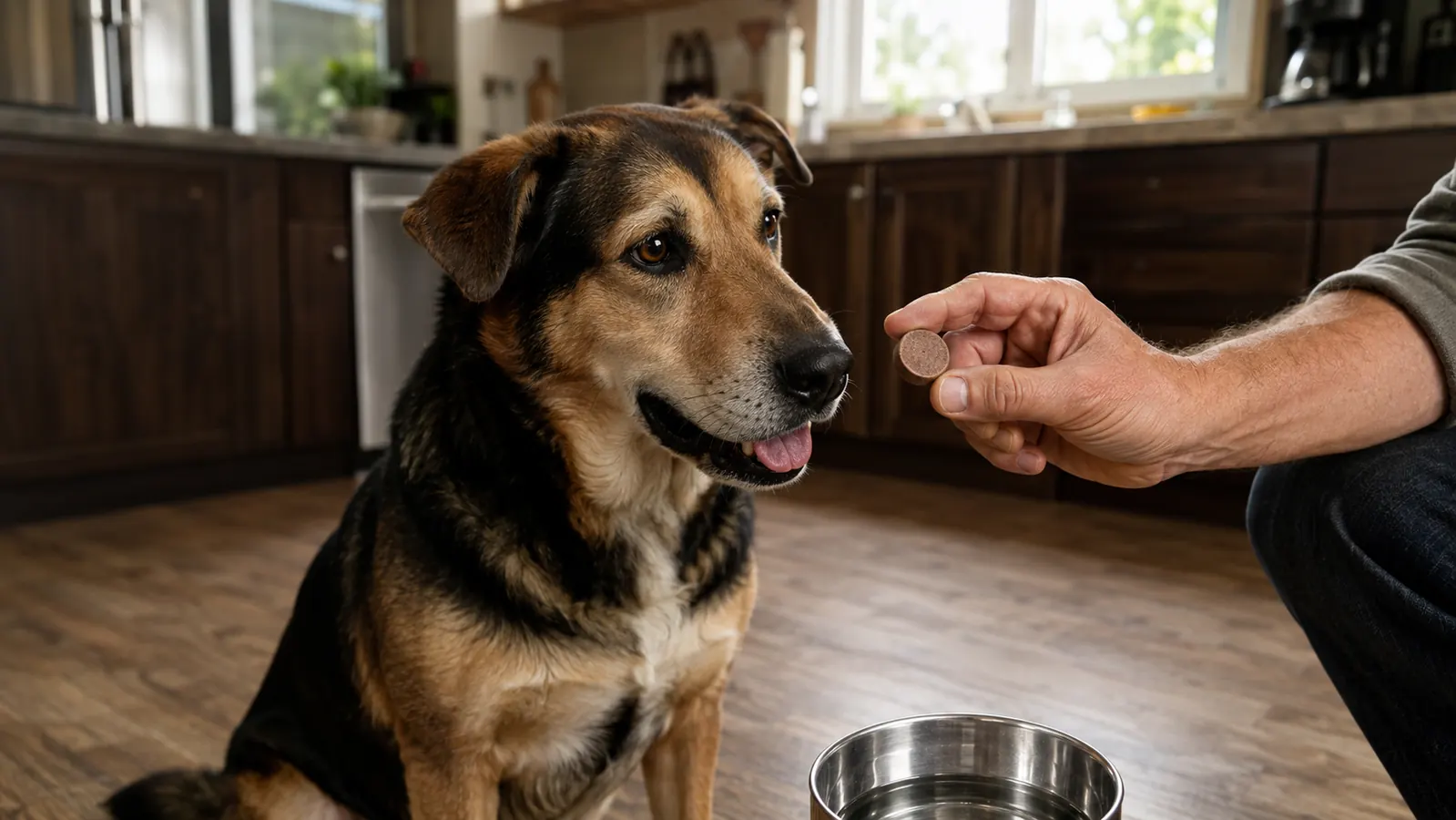
The tablet is about the size of a quarter, maybe smaller. It has a smell I can only describe as meaty supplement, not bacon. Juno does not care about the smell; she eats it without hesitation. That matters more than you think, because a joint supplement you have to fight your dog into eating twice a day is a supplement you will stop giving by the second week. I never had to hide it in cheese. I know owners who do.
Before I started, I asked our vet if she thought it was worth trying. She said it was reasonable for a dog her age with mild hip tightness, as long as I watched her weight and kept her moving. She also said something I wrote down: supplements do not work like pain pills. They do not fix a joint overnight. They give the body material to work with, and that takes time. She was right about the time part. I have learned to listen to her, because she does not sell supplements and she does not get a cut of what I order.
What Nobody Tells You Before You Buy
Most reviews you will read say it helped, and that is true, but almost none of them say how long it took. For Juno, the change showed up around the three week mark. One morning she took all eleven deck steps without pausing at the top. I did not notice it on the first try. I noticed it because I looked back at my notes and the pause had simply stopped appearing. The change was real, and it was quiet.
The second thing nobody tells you is how much your dog will want these. They are a chew, which means they are flavored to appeal to a dog. Juno learned the sound of the bottle cap from two rooms away. I keep the bottle in a cabinet above the stove because if I left it on the counter, she would find a way. My neighbor's dog would not touch them, so your results may vary, but plan for a dog who suddenly thinks you are the best snack dispenser alive.
The third thing, and the one I wish someone had said plainly, is that this is a maintenance product. It only works while you give it. In late June the bottle ran out and I waited five days to reorder. By day five, Juno was pausing at the top of the stairs again. I restarted the chew and the pause faded over the next couple of weeks. Whatever these tablets do, they do not build a permanent reserve. You are signing up for the long game.
And the last honest note: if your dog has real joint disease, surgery-level lameness, or a sudden limp, a chew tablet is not the right next step. That is a vet visit, not an Amazon order. Cosequin is for the slow, grumbly stiffness of an older dog, not for a dog in real pain.
What's Actually in the Chew (the Part I Had to Look Up)
Cosequin combines three things you will see on the label: glucosamine hydrochloride, MSM, and hyaluronic acid. Glucosamine is the building block your dog's body uses to make cartilage, MSM is a sulfur compound often added for joint comfort, and hyaluronic acid shows up in joint fluid. I am describing labels, not prescribing. I am also not going to pretend the science is settled, because it is not. Study results in dogs are mixed, and any brand that tells you its supplement is a guaranteed fix is selling you something.
What pushed me toward this specific bottle, honestly, was the manufacturer. Nutramax Laboratories is the company behind Cosequin, and they are one of the few supplement makers that actually fund research on their own products. They also make Dasuquin, a similar chew that adds ASU, which I will mention again in the alternatives section. A brand with a research budget is not the same as proof, but it is more than most bottles on the shelf can say.
The label instructions are straightforward, but read the fine print anyway. Some joint chews want a double dose for the first month, what the industry calls a loading period, and you do not want to double up two different supplements and accidentally give your dog more than the label allows. If your dog is already getting another glucosamine product, talk to your vet before stacking them. A quick call to the vet's office took care of my questions in one afternoon.
Five Months In, Here Is the Honest Timeline
I gave Juno Cosequin every day from March through July, with that one gap in June. Here is the timeline I actually recorded. Week one, she ate the chew happily and nothing changed, which I expected. Week two, nothing visibly changed, and I started wondering if I was chasing a trend. Around the middle of week three, the morning stiffness got shorter. She still walked stiff for a step or two, but she did not need the full warm up anymore.
By the second month, she was trotting to the fence to bark at the neighbor's dog again, something she had stopped doing the winter before. By month three, the change felt ordinary, which is the strange thing about a supplement that works slowly. You forget what the before looked like because the after becomes your normal. That is why I kept the notebook. When I doubted the product, I could read back and see that the pauses really had gone away.
The June gap was the most informative part of the whole experiment, even though it was an accident. Five days without the chew and the stiffness came back, not as bad as February, but clearly back. When I restarted, it took about two weeks for her to settle again. If you travel a lot or forget daily pills, be honest with yourself about whether you will keep this up, because the benefit appears to be tied to the giving. That week told me more than the five good months did.
One more honest thing: Juno is still an 8-year-old dog. She still slows down on hot afternoons, she still takes a minute to get up from a deep nap, and she still prefers the couch to the floor. Cosequin did not make her young. It made her comfortable, and that is a smaller and more realistic promise than the ads imply.
Three weeks after Juno started these chews, she stopped pausing at the top of the stairs. That is the honest timeline, and the progress only lasts while you keep giving them.
The Tradeoffs Nobody Mentions
The first tradeoff is palatability, and it cuts both ways. Juno loves the chews so much that the bottle has to live in a cabinet. My neighbor's dog, a picky shepherd mix, turned up her nose for three days before she would eat one. If you have a dog who refuses them, do not assume the product is bad. Try crumbling it over food or offer it before a walk when the dog is hungry.
Then there is the routine itself. A chew that works only while you give it is a chew you have to give every single day. That sounds easy until you have a busy month. I set a daily reminder on my phone and I still missed a week in June. If you know you will not keep a daily routine, a monthly injection your vet gives, or a prescription joint diet, might honestly serve your dog better.
And watch for the things that are not about the product. Juno gained about two pounds over the winter, and our vet reminded me that every extra pound on an older dog is weight on those hips. The chew is not a license to skip walks. It worked best for us when I paired it with shorter, more frequent walks and a little less kibble at dinner.
None of these tradeoffs made me stop using it. They just made me use it with my eyes open. If someone tells you a joint supplement works overnight and lasts forever even after you stop, that person is describing a different product than the one I used.

Alternatives I Considered (and Why I Stayed)
Nutramax also makes Dasuquin, which adds ASU, a compound from avocado and soybean that some research suggests helps cartilage. Dasuquin is the next step up in the same family, and my vet said Juno did not need the extra ingredient yet. If your dog has more advanced joint changes, it is worth asking your vet about. I also looked at Zesty Paws and other soft chews, which many owners swear by, but the research trail for Cosequin is longer, and that mattered to me.
Another option is plain human glucosamine, but dosing a dog from a human bottle is fiddly and easy to get wrong. Our vet's view was that a product made for dogs, with dog-sized dosing and a research base, was worth choosing over a gamble. On the flip side, if your dog refuses every chew you try, do not fight it. Ask your vet about a coated tablet you can cut, or a prescription joint food, because the best supplement is the one your dog will actually take.
One thing I did not do was switch to a different brand every time an ad promised better results. Juno's stomach is sensitive, and I learned years ago that her system does better when we change one thing at a time. Cosequin was the change, and the notebook told me it was working, so I stayed with it.
What I Liked
- Juno ate it like a treat, no pilling, no hiding it in cheese
- Morning stiffness eased after about three weeks and stayed manageable for months
- One bottle lasted me several months, so reordering was not a constant chore
- Nutramax funds research on Cosequin, which is more than most supplement makers do
- The routine is simple: chew tablet on top of dinner, no measuring, no syringe
Where It Falls Short
- Results took about three weeks, and week two almost made me quit
- The chews smell strongly and a determined dog will find the bottle if you leave it out
- The benefit faded within days when I ran out, so this is a daily commitment, not a one-time fix
- Not for real pain or sudden lameness, that is a vet visit, not a supplement
- One more daily task that is easy to forget on a busy week
Who This Is For
Buy Nutramax Cosequin if your dog is past the puppy stage and you are seeing the slow signs of age: a pause at the top of the stairs, a stiff start on damp mornings, less bounce at the start of the walk. It is for the dog whose joints are tired, not broken. It is also for owners who can stick to a daily routine and who want to try a researched supplement before asking the vet about stronger options.
If you decide to try it, pick a start date and take a photo of your dog on the stairs in week one. That photo becomes your proof, because a slow supplement fools you into thinking nothing happened until you look back.
Who Should Skip It
Skip it if your dog is suddenly lame, crying out, or refusing to put weight on a leg, because that is pain, not aging, and it needs a vet. Skip it if you know you will not give a chew every day for months, since the benefit faded within days of stopping for us. And if your dog is already on a prescription joint diet or another glucosamine product, ask your vet before stacking supplements, because more is not automatically better.
The Bottom Line From My Kitchen Table
If you are standing in the supplement aisle trying to decide, here is my honest bottom line. Cosequin did not turn Juno back into a puppy, and you should be suspicious of any product that promises that. What it did was simpler and more useful. A stiff older dog got easier on the stairs after about three weeks, and she stayed that way as long as I kept giving her the chew every day. To me, that is a realistic outcome worth trying before you move on to stronger options.
Start with the 250-count bottle, take notes for a full month, and judge it on what you actually see, not on what the ads promise. If your dog is like Juno and eats it happily, the hardest part is the daily habit. If your dog refuses it, you will know within a week and you can try another approach. Either way, you will have spent a month learning what your own dog needs, and that is never wasted time.
Try it for a full month before you judge it
Juno's change showed up around week three, not week one. Give Nutramax Cosequin a full month with your own dog, keep a few notes about the stairs, and then decide with your eyes open. The button below takes you to today's listings and the newest owner reviews.
Amazon Check Today's Price on Amazon →